

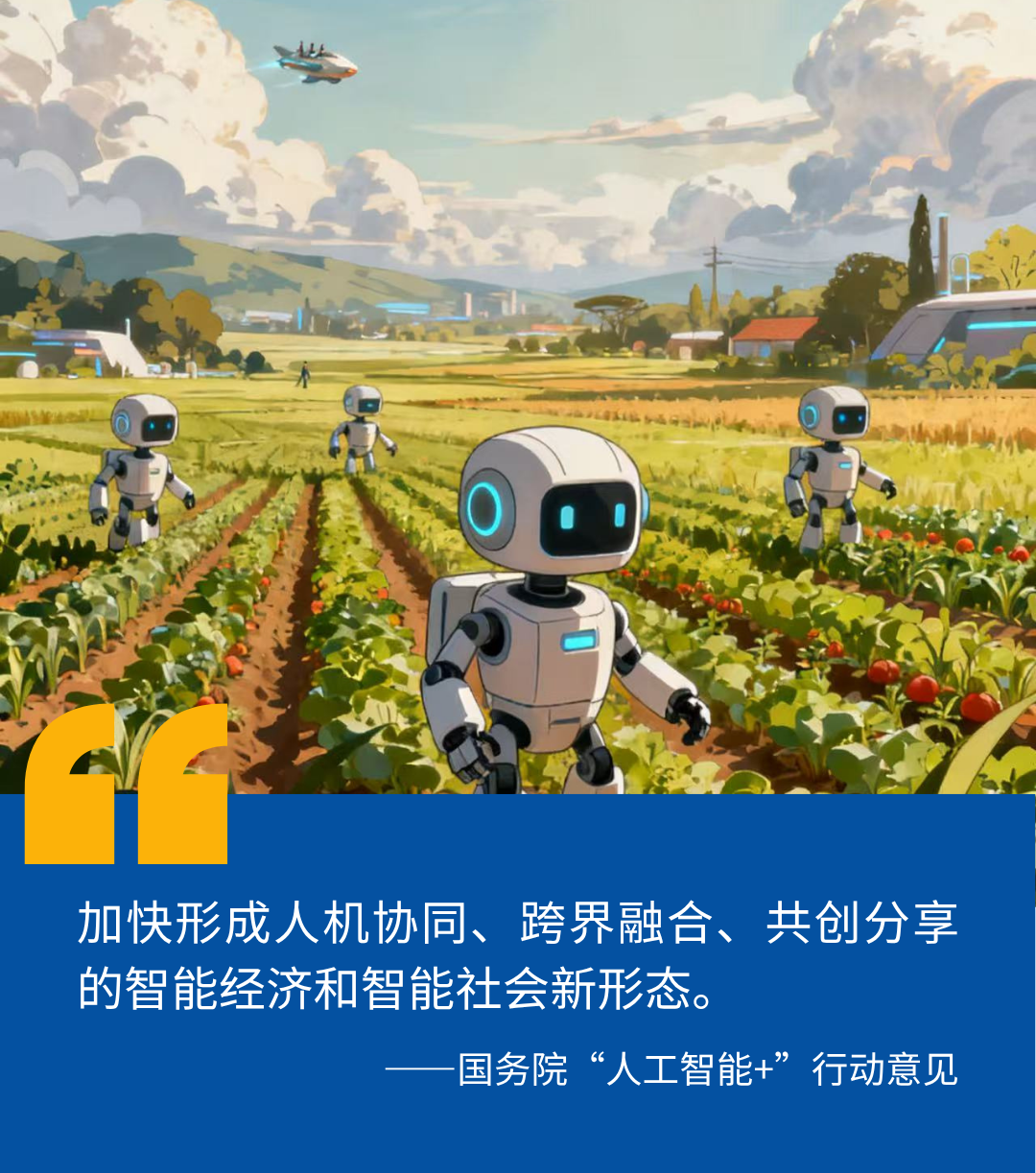
*This image is AI-generated and for reference only.
Introduction
If the 2025 Spring Festival Gala made humanoid robots an overnight sensation, prompting industry insiders to exclaim "The springtime for humanoid robot 'geeks' is here!", then two other highly anticipated humanoid robot sports competitions brought them crashing back to reality.
"Great at performing, but struggling in real combat"—this stark contrast highlights a common dilemma in the industrialization of humanoid robots: a "body" growing stronger, but a "brain" yet to awaken. "These issues are essentially caused by a 'lack of intelligence,'" pointed out Sun Bo, founder of Lingjing Zhiyuan, an incubated company of the Shanghai Artificial Intelligence Research Institute. This is not an isolated case, but an epitome of the entire industry.
According to data analysis from the International Federation of Robotics (IFR) "World Robotics Report 2025", many domestic manufacturers are still stuck in the "purchasing core components + assembly and integration" model stage. Among these, the three core components—reducers, servo systems, and controllers—account for over 70% of the total machine cost. In particular, the "brain" aspects like controllers and operating systems are not yet fully self-sufficient. In other words, the "form" can be built domestically, but the "spirit" is still in others' hands. In this context, achieving independent innovation in "brains and cerebellum" like controllers and specialized operating systems is particularly urgent.
With over a decade of experience in industrial measurement and control and intelligent robotics, Sun Bo believes that AI should not just "show off skills" on stage, but also enter factories, homes, and competition fields, achieving the ability to "perceive, make decisions, and execute." "Physical AI, or Embodied Intelligence, is an important engine for new quality productive forces," said Sun Bo.

Guest of This Issue
Sun Bo
Founder & CEO, Lingjing Zhiyuan
Director, Intelligent Brain Innovation Center, Shanghai Artificial Intelligence Research Institute
01
Humanoid Robots Are Generally "Strong in Body, Simple in Mind"
"Generative AI can 'say' 'how to pick up a package,' but Physical AI has to 'do' it and autonomously recognize surrounding physical variables." When discussing the difference between Physical AI and other AI forms, Sun Bo stated that the core capabilities of Physical AI can be summarized into five key dimensions:
l Real-time Multimodal Interaction: Accurately capturing data like temperature, force sensation, and vision from the physical world, forming the basis for dialogue with the environment;
l Large Model-driven Decision Making: A comprehensive enhancement from "perception" to "decision-making" capabilities, utilizing large models to decompose and reason complex instructions;
l Virtual-Real Integration Technology: Relying on simulation and digital twins, allowing AI to "train" in virtual scenarios before deployment in the physical world;
l Hardware-Software Co-evolution: Algorithms cannot be separated from hardware; they must be optimized and adapted based on the robot's joint structure and computing power capacity;
l Breakthrough in Embodied Intelligence Generalization: Ultimately breaking through "single-scenario adaptation," enabling robots to switch flexibly between scenarios like homes, factories, and hospitals.
·
Taking "picking up a package" as an example, when the AI receives the instruction, the transition from "knowing to pick up a package" to "how to pick up a package" relies precisely on "large model-driven decision making": the large model first decomposes the instruction – "leave the room → find the hallway shelf → identify the package belonging to 'me' → grab the package → return to the room." During this process, it handles unforeseen situations: for example, if a passerby is in the hallway, it autonomously plans a detour; if packages are densely stacked on the shelf, it decides to first move the outer packages to get the target one; if the shipping label information is unclear, it further confirms by scanning the barcode – these dynamic decisions are not based on preset programs but are the results of the large model's real-time reasoning.
In Sun Bo's view, the value of Physical AI is essentially about moving artificial intelligence from "being able to talk" to "being able to do things," truly integrating it into all industries. "The reason artificial intelligence is called the 'Fourth Scientific and Technological Revolution' is its key ability to solve productivity problems," he further stated. The development of AI must inevitably couple with real scenarios to transform into new quality productive forces and drive industrial upgrades.
It is this dedication that makes him more keenly aware of industry pain points: "Most general-purpose robots have strong locomotion but commonly 'lack intelligence.'" The problems exposed in two professional humanoid robot competitions this year also confirm this point.
In the world's first humanoid robot half marathon, only 6 out of 20 teams finished the race; at the World Humanoid Robot Games, the completion rate for the 100-meter obstacle course was below 30%, with scenes of robots "face-planting" right at the start being common.
The reasons can be analyzed from two aspects: Hardware-wise, there is a lack of high-performance computing platforms that can support multimodal perception and real-time decision-making; Software-wise, there is a lack of "brain algorithms" matching physical scenarios. The disconnect between the two leaves robots with agile "limbs" but no "brain" to command them to "act intelligently."
02
Lingjing Zhiyuan's Domestic Breakthrough
Solving the "Lack of Intelligence" Pain Point in General-Purpose Robots
The global humanoid robot market is on the eve of an industrial explosion, with the contradiction between market scale expansion and core technological bottlenecks becoming increasingly prominent. According to data from the "2025 Humanoid Robot and Embodied Intelligence Industry Research Report," the scale of China's humanoid robot market is expected to reach 8.239 billion yuan in 2025, accounting for 50% of the global market share. By 2030, the scale of China's embodied intelligence market may reach 103.752 billion yuan, accounting for 44.6% of the global market.
However, although domestic manufacturers have advantages in market share and application scenarios, the core computing platform has long been dominated by two overseas giants, leading the industry to face the triple dilemma of "import dependence on edge computing power, potential data security risks, and persistently high hardware costs," becoming a key bottleneck restricting industrial autonomy.
Against this backdrop, Lingjing Zhiyuan, incubated by the Shanghai Artificial Intelligence Research Institute, focuses on the core computing needs of embodied intelligence, developing a new generation of edge/end-side computing platforms. It adopts a "dual-track strategy" with the N Series focusing on compatibility and adaptation and the T Series focusing on a fully domestic stack, precisely solving the "lack of intelligence" dilemma of general-purpose robots.
Among these, the N Series is positioned around "extensive compatibility," seamlessly adapting to the hardware architectures and open-source operating systems of mainstream overseas manufacturers. For enterprises already using imported computing platforms for R&D, they can integrate Lingjing Zhiyuan's self-developed decision-making algorithm modules at low cost without replacing existing hardware. This not only addresses current needs for robot motion coordination and scene adaptation but also provides flexible space for enterprises to choose technical routes based on their own development plans in the future, avoiding resource waste from prior equipment investment.
The Zhijing T Series, however, is the core product anchored in domestic innovation. This platform supports domestic operating systems + real-time kernel + robot operating system, achieving full-link autonomy from underlying hardware to upper-layer applications. Its technological foundation stems from the world's first "Dvorak" super-heterogeneous architecture. Through the innovative design of "physical integration, logical separation," it reconstructs the logic of computing power allocation and data interaction, thoroughly solving the industry pain point of "asynchronous coordination between the decision-making layer (brain) and the motion control layer (cerebellum)" in traditional platforms, significantly improving the real-time performance and accuracy of robot motion response. In terms of performance data, the T Series achieves computing power gradient coverage, capable of delivering up to 1500 TOPS of dense computing power at the edge, sufficient to support real-time processing of multimodal perception data and complex scene decision-making.
Currently, China's robotics industry has achieved breakthroughs in domestic production of components like reducers and sensors. The autonomy of core computing platforms is becoming the "final piece of the puzzle" to complete China's humanoid robot industry chain. Lingjing Zhiyuan's "silicon-based brain" aims to be the core carrier of this puzzle piece, providing the industry with reliable, optional autonomous solutions.
03
Lowering Barriers to Break "Cannot Use"
The Lingjing Ecosystem Solves "Cannot Use Well"
"The best technology is meaningless if it cannot be used." When discussing the bottlenecks in the development of the embodied intelligence industry, Sun Bo believes the key to breaking the deadlock lies in "lowering barriers" and "building an ecosystem."
The core of lowering barriers is, first, "compatibility with the mainstream." Sun Bo uses computer systems as an analogy: "Just like systems with different underlying architectures cannot directly run each other's programs, if our platform only supports specific systems, customers will just find it troublesome to use." Based on this, Lingjing Zhiyuan's product design covers mainstream software systems both domestic and international. "Customers no longer need to worry about 'whether it can be used,' but can directly focus on 'how to use it.' This is the first step in lowering the barrier."
The deeper support for lowering barriers lies in "full-chain empowerment." Beyond compatibility with mainstream systems, Lingjing Zhiyuan has also established a dedicated application engineering team. "Our team is here to help customers overcome application bottlenecks, providing remote collaboration and technical support," Sun Bo said.
If lowering barriers is "tearing down the walls," then building an ecosystem is "building the roads." Sun Bo defines it as the "Lingjing Ecosystem," divided into two major directions: "upstream synergy" and "downstream cooperation." Upstream, the focus is on core component adaptation, compatibility with domestic chip modules, and even guiding upstream manufacturers to optimize their products to better fit the needs of the embodied intelligence sector. Downstream, targeting the know-how of different industries, a "division of labor and collaboration" model is adopted. Lingjing Zhiyuan provides the computing platform technology, while partners contribute their scene experience, jointly developing adaptation solutions. "We don't understand the specific needs of agricultural scenes, but agricultural leaders do; they lack core computing technology, which we can provide. This complementarity is the value of the ecosystem," Sun Bo explained the core logic of the "Lingjing Ecosystem."
The stable operation of the "Lingjing Ecosystem" relies on the underlying support of the "three major concepts" in product design: "Excellence, Leadership, Empowerment." "Excellence" is the pursuit of breakthroughs in hardware performance and software stability, laying a solid foundation for the ecosystem. "Leadership" is about exceeding customer expectations, making customers exclaim "This is exactly what I wanted!" when they receive the product, and even uncovering needs they hadn't realized. And "Empowerment" returns to the essence of the ecosystem: through modular architecture and open compatibility, enabling ecosystem partners to rapidly develop products adapted to their own scenarios based on Lingjing Zhiyuan's platform.
04
Three Key Technological Breakthrough Directions
Hardware-Software Co-evolution, Virtual-Real Fusion, Multi-Agent Collaboration
In Sun Bo's view, current embodied intelligence is still in the stage of "single-agent deployment." The real industrial transformation will come from leaps in three key technological directions, which are both opportunities for the industry and the future core focus areas for Lingjing Zhiyuan.
The first breakthrough direction is the deep upgrade of hardware-software co-evolution. Future embodied intelligent devices will no longer suffer from mismatches like "high-end chips cannot run basic motions" or "simple hardware cannot handle complex decisions." For example, the flexibility of a robot's joints will directly feed back into the algorithm's motion planning logic; the allocation of edge computing power will dynamically adjust based on physical quantities captured by sensors in real time. This kind of "synchronization between hardware characteristics and algorithm logic" will allow embodied intelligence to ensure motion precision while avoiding computing power waste in scenarios like industrial assembly and medical care.
The second breakthrough direction lies in the further narrowing of the gap between the virtual and the real. Sun Bo mentioned that there is already technology that can generate training scenes under different physical conditions in simulation systems. However, future digital twin technology will achieve "seamless connection between virtual training and physical deployment."
The third is the leap from single-agent to multi-agent collaboration. "The future of embodied intelligence is not about 'a single robot doing everything,' but about different intelligent agents collaborating," Sun Bo explained. Multiple agents will interconnect through unified communication protocols to accomplish complex tasks together. Lingjing Zhiyuan is already developing multi-agent communication protocols and modular collaboration technologies to lay the groundwork for this trend.
Looking further ahead, what Lingjing Zhiyuan aims to do is become the "general technology platform" for the era of embodied intelligence. "We will not limit ourselves to a certain type of device or a specific scenario. Instead, we want our computing foundation and software ecosystem to be adaptable to various embodied intelligence forms like humanoid robots, robotic arms, and smart home appliances." The future "Lingjing Ecosystem" will be centered around the technological foundation, upwardly compatible with more domestic core components, and downwardly collaborating with scenario parties across all industries, truly allowing embodied intelligence technology to "enter every corner that needs it."
When hardware-software co-evolution becomes smoother, virtual-real fusion tighter, and multi-agent collaboration more mature, embodied intelligence will no longer be a technical concept confined to laboratories. Instead, it will become a "productivity partner" capable of precise operation on factory assembly lines, attentive care in homes, and efficient picking in farm fields. Lingjing Zhiyuan, with its "domestic edge/end-side computing platform" as the hub, is pushing for the arrival of that day.